Hiring talent is no longer your biggest challenge. Integrating it in five days is.
I’ve seen more than one CIO forced to reset their talent strategy every quarter. The pain point is always the same: finding candidates is one thing; getting them to arrive, deliver, and stay is something else entirely. What derails projects isn’t hiring — it’s integration velocity and 90-day retention. That’s where conventional strategies fall apart.
Why the U.S. CIO talent strategy can’t ignore talent that delivers in days — not months
The pressure on your team isn’t small:
- Implement AI without fail
- Migrate to SAP without delays
- Launch features before your competitors
And all this in a market where only 40% of the demand for critical roles (DevOps, QA, Data) is being met.
This gap has a clear cause: pressure from tech giants and fast-moving trends. From generative AI at Nvidia GTC to SAP S/4HANA migration at Sapphire — these aren’t future plans. They’re live deliverables.
So, the obvious question is:
How do you scale your team without paying the price of chaos or scarcity?
You don’t need more resumes. You need people who turn your team into delivery — not into promises. That’s where a well-executed nearshore strategy makes the difference: cultural and time zone proximity means your project moves forward now, not after the next status update.
And no, this isn’t about dots on a map. It’s about people who jump into your team like it’s their own — and start delivering in sprint one.
It’s no coincidence that Mexico is emerging as a strategic tech hub for U.S. companies.
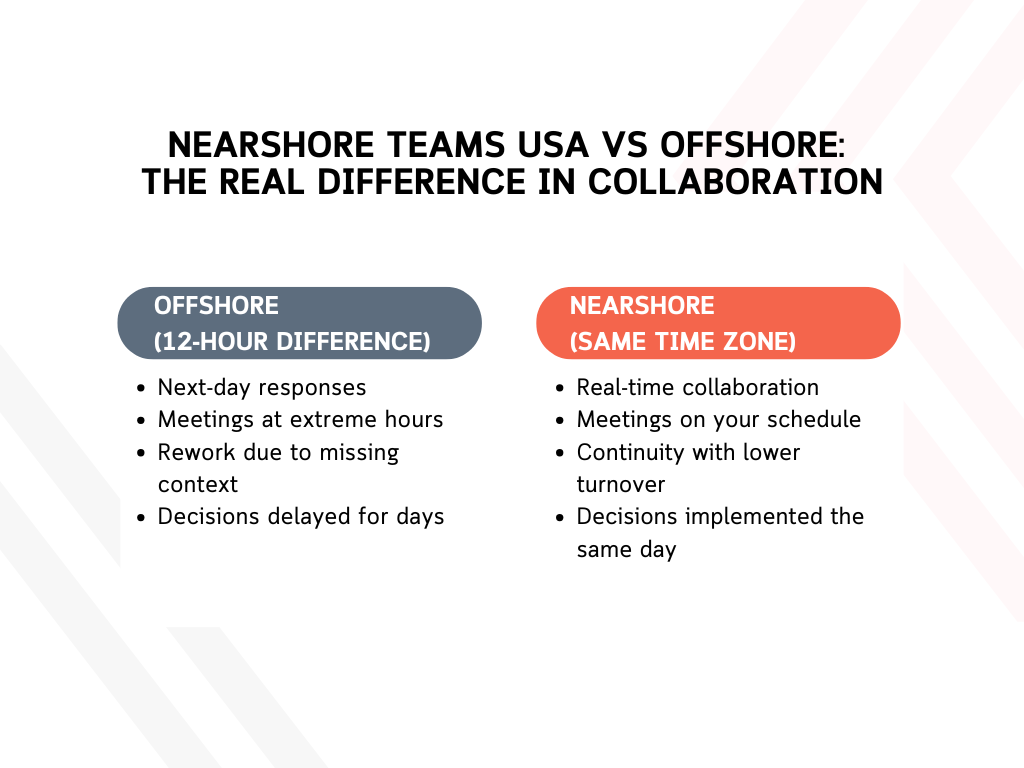
Nearshore vs offshore: what no one tells you about delivery, culture, and IP
It’s not about where your developer lives — it’s about how that choice impacts your business.
Offshore projects that looked perfect on paper often collapsed due to one silent killer: misalignment.
It’s not just the delay in meetings or the timezone gap. When your team needs to move in five days, you can’t afford a partner who moves in three-week cycles. That’s where your U.S. CIO talent strategy gets stress-tested.
A broken model turns into friction. But nearshore teams USA flip the script:
- Technical decision + offer + pre-onboarding in 5 days
- Cultural fit assessed during the process — not after
- SOC2-compliant contracts and U.S.-style IP clauses
- Most importantly: early retention rates above 97%
How many projects could’ve been saved with just 90 days of stability?
Far more than many reports will admit.
How nearshore teams USA turn urgency into execution
A great candidate only adds value if they match your company’s rhythm. If not, it’s just another name on a spreadsheet.
The biggest mistake? Thinking this is about process.
It’s not.
It’s about people — connecting your business urgency with talent that doesn’t just meet expectations but raises the standard.
As an engineer, I naturally break down problems into actions. But even the best blueprint is worthless without the right team to build it.
That’s why I live by two rules:
Build teams that play with heart.
Where people don’t just add — they multiply.
And never assume there’s only one right answer.
The most powerful solutions come from blending perspectives.
Bottom line: raise the bar — or stay stuck.
My role isn’t to “send resources.” It’s to make the right connection happen — with business context, clear expectations, and onboarding that makes people feel like part of the mission from day zero.
Your U.S. CIO talent strategy can’t stay still
If you want your nearshore strategy to actually work, these four practices aren’t optional:
1. Alignment from day one
Great nearshore doesn’t start with hiring. It starts with calibration:
- Culture mapping
- Real targets for days 30, 60, and 90
- Shared expectations
When you get this right, 90% of the shortlist builds itself.
2. Surgical shortlist, not a massive catalog
You don’t have time for 12 interviews. The right model puts 3 validated profiles on your desk within 72 hours. That keeps execution in motion.
3. Onboarding starts with the offer
No weeks of lag time. The team member arrives with credentials set, sprint planned, and a “buddy” assigned. Real productivity in under five days.
4. Service delivery that protects your roadmap
This isn’t about tracking dashboards. It’s about spotting blockers early, measuring satisfaction, and improving in real time. When that’s in place, people don’t just execute — they grow.
Miss one step and the model breaks. Nail all four, and nearshore becomes your performance multiplier.
At Proceti, we don’t treat this like a checklist — we treat it like a living partnership.

When your U.S. CIO talent strategy becomes momentum
Sticking to traditional hiring misses the most decisive move in the tech game: execution.
Well-built nearshore teams USA aren’t just more capacity.
They’re the lever that turns strategy into momentum.
Our pride isn’t in filling a vacancy.
It’s in creating that moment where three sides win:
- You get execution without friction
- The consultant gets a challenge that grows their career
- We fulfill our promise to be the agile bridge that makes it happen
The truth is simple: technology doesn’t wait.
Your teams shouldn’t either.
If you’re ready to stop hiring and start executing with rhythm, let’s talk:
📧 mario.espinoza@proceti.com
We are the ones with the perfect IT match.
— Mario Espinoza
Commercial Director, Proceti
Engineer. Builder. Traveler.
Still convinced that in tech — as in life — trust matters. But what really moves things forward is raising the bar.